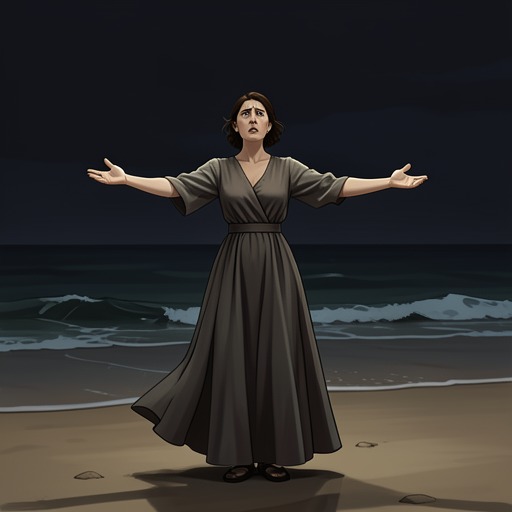
Marcia Schuyler
Not Without HopeMarcia Schuyler is Nick Schuyler’s mother and one of the central emotional figures in the account of the 2009 Clearwater boating accident. Her importance is established not through a role in the boat’s mechanics or the Coast Guard search, but through the bond that Nick carries into the water: the fear of causing her unbearable grief becomes the most intimate explanation he can offer for why he survived when Marquis Cooper, Corey Smith, and Will Bleakley did not.
Identity and Family Background
Marcia Schuyler is portrayed as a mother who repeatedly placed her children’s needs ahead of her own. Nick recalls that her marriage had been difficult, yet she remained a peacemaker until he was nearly finished with high school. Her habitual reassurance that she was fine concealed how much strain she had endured, while her attention remained fixed on Nick and Kristen Schuyler.
Her care was practical as well as emotional. When Nick was growing up in Ohio, she volunteered at his elementary school, helped with fund-raisers, chaperoned field trips, and made ordinary domestic moments feel secure. He remembered resting on her lap while they watched television and resisting bedtime by saying, “No, I’m just going to rest my eyes.” She called him “Nick Butt,” a private family nickname that condenses the tenderness and familiarity of their relationship.
Marcia never missed one of Nick’s high-school games. She kept statistics and a scrapbook of newspaper clippings from his basketball and football careers, then worked as a paralegal and took out loans to help him attend Kent State University during his freshman and sophomore years. When he moved to Florida in 2005 and worked painting jobs for his father’s business, she refused to let him remain dependent on her, insisting that he return to school. When he was too nervous to call the University of South Florida admissions office, she made the call for him. During his time at school, she even allowed him to charge food on her credit card.
Marcia later moved to Florida to live near Nick and Kristen. She drove two hours from Fort Myers to Tampa to watch Nick play flag football on Saturday mornings, sometimes cooked or cleaned at his house, and bought the orange jacket he wore in the cold Gulf water. The jacket becomes a concrete trace of her care inside the disaster: an everyday gift helps preserve Nick’s body during the ordeal.
The Mother as Nick’s Reason for Survival
Nick’s opening reflection returns insistently to the question of why he lived. His three companions were also young, strong, athletic, and brave; two, Marquis Cooper and Corey Smith, had played in the National Football League, while Will Bleakley had been a college tight end and Nick’s best friend. Nick rejects the idea that survival proves superior courage or worth. The explanation he can bear is personal: he could not have Marcia come to his funeral.
That thought gives the accident a moral and emotional dimension beyond physiology. Nick acknowledges that science might explain survival through warm air trapped against the skin and the maintenance of core body temperature, but he finds that explanation insufficient. In his telling, Marcia’s place in his imagination is not a supernatural mechanism but the human meaning attached to endurance. The possibility of her seeing her twenty-four-year-old son in a casket, or never recovering his body from the sea, becomes a reason to keep resisting death.
During the night, as the four men huddle against the overturned boat to preserve body heat, Nick thinks about Marcia’s devotion to him and Kristen. Their cluster of bodies in the Gulf is a desperate survival measure, but his thoughts connect that physical struggle to the family care that shaped his life. The men speak about unfinished obligations and the changes they might have made; Nick’s memories of Marcia make clear that he understands love as something demonstrated through years of action rather than declared only in crisis.
When Nick’s condition deteriorates, he prays for Marcia as part of the family he hopes to protect. He asks God to find him and, if he does not survive, to protect his mother, sister, father, Paula Oliveira, and his dogs. The prayer makes Marcia both the person he fears losing and the person whose welfare remains his responsibility even while he is freezing, exhausted, and stranded at sea.
Learning of the Disappearance
Marcia does not initially receive Paula Oliveira’s call because she is at home with Kristen. The missed call briefly spares Paula from having to tell a mother that her son has not come home, but the delay only postpones the shock. When Kristen explains that Nick has not returned from the fishing trip, Marcia goes to the bathroom and vomits. She and Kristen throw clothes into a bag, take a shower, and leave for Tampa; Kristen hears her mother sobbing in the shower.
The reaction is immediate and physical because the disappearance is not an abstract report. Marcia has spent Nick’s life monitoring his games, supporting his education, traveling to see him, and worrying whenever anything happened to him or Kristen. Now the same protective instinct meets an emergency too large for a mother to control. Nick’s father, Stu Schuyler, is also upset, having warned Nick the previous morning that the weather was expected to worsen and told him to come home early.
The search itself is made harder by the conditions and by the absence of an emergency position-indicating radio beacon. The Coast Guard must search for a possible overturned boat in storm-darkened seas, where only a small portion of a white hull might be visible among countless whitecaps. Captain Timothy Close explains that a beacon could have sent a unique satellite signal identifying the boat and its location; without one, the operation remains a probabilistic search rather than an immediate rescue. Marcia’s fear therefore grows inside an information vacuum: she knows her son is somewhere offshore, but not whether he is in the boat, in the water, or already beyond help.
Waiting, Calling, and Holding on
Marcia and Kristen spend the night unable to sleep. Marcia dozes in the living room only to wake and throw off the covers because she cannot accept being warm while Nick may be freezing in the Gulf. She refuses food and drink because Nick has none. Sitting with clenched fists, she repeatedly urges him to keep going, sometimes feeling guilty because she is not saying the names of Marquis, Corey, and Will as well.
At 9:59 on Sunday, March 1, Marcia sends Nick a text message: “I luv u so much no u will b safe please stay strong u make me so proud of u!” The message is not delivered until March 5, after the crisis has passed, and Marcia keeps it on her phone for eight months. Its delayed arrival embodies the separation imposed by the sea: her words travel toward him, but cannot reach him when they are most needed. Even so, the message preserves the exact shape of her response—love, confidence, pride, and an appeal for strength.
She and Kristen repeatedly call the Coast Guard for updates. Marcia apologizes for being a nuisance while insisting that the missing person is her son. When she learns that a cutter has been pulled back because of twelve- to fourteen-foot seas, her patience breaks into anger. She cannot accept that a vessel cannot remain in the waves while Nick is still out there. Her persistence is not presented as a technical contribution to the search; it is the family’s refusal to let the missing man become merely a position in a search grid.
Reunion and Lasting Significance
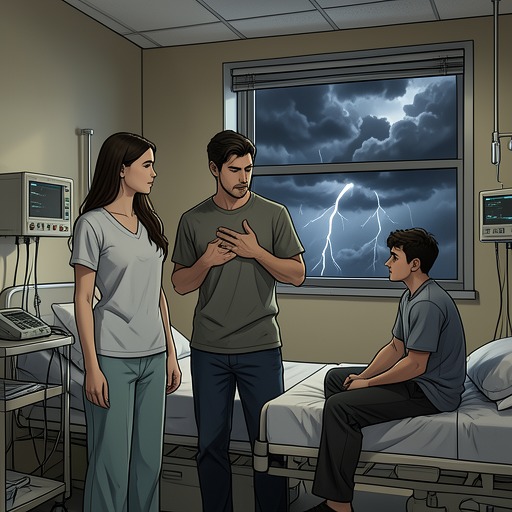
When Captain Close finally calls and confirms that Nick has been found, he introduces himself to Marcia and answers her direct question: “Yes, ma’am, we did.” She immediately says that she needs to get to her son. At Urgent Care, she walks into a room where Nick lies on a bed connected to intravenous tubes, surrounded by doctors. The scene feels unreal to her because the anticipated categories—dead, missing, or alive—have not yet settled into ordinary comprehension.
Marcia touches Nick’s hand and finds it cold. She bends down, kisses him, and tells him, “God, Nick, you scared the hell out of me.” Nick answers that he knows. The exchange is brief, but it completes the emotional arc that began with her frantic waiting: fear is transformed into physical contact, and the mother who could not bear to see her son in a casket sees him instead under medical care, still capable of answering her.
Her presence also remains with Nick after the rescue. At the beginning of his account, he identifies her suffering as part of the reason he endured. At the end, his memorial tattoo binds the four men together with their initials, a Celtic cross, rope, anchor, the date March 1, 2009, and the words “In the hour of adversity, be not without hope.” The tattoo is primarily a memorial to the men who died and to the cooperation that helped Nick live, but its emotional force also returns to Marcia: the survival she feared might become a source of lifelong pain is transformed into a responsibility to tell the story accurately and to honor the families left behind.
Marcia therefore functions as more than a grieving relative or rescue witness. She is the living measure of what Nick believes was at stake in the Gulf of Mexico. Her years of sacrifice explain the depth of his attachment to life; her sleepless waiting gives the search a domestic and emotional counterpart; and her touch at the hospital turns survival from a bare biological fact into a reunion. Through her, the narrative repeatedly insists that the meaning of rescue is not simply that one man came out of the water, but that someone who had spent his life protecting him was spared the finality of losing him.